
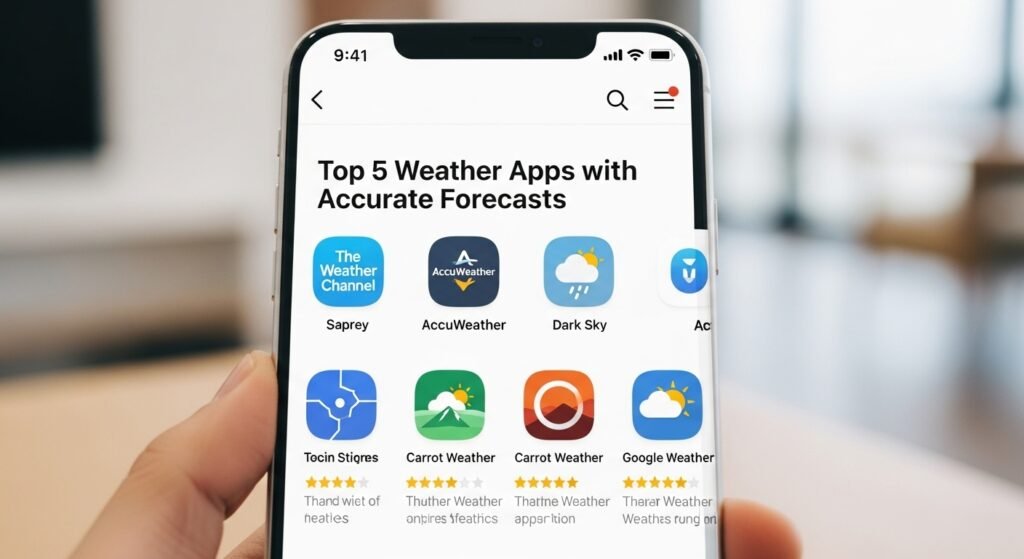
Accurate weather forecasts shape how we plan our days—whether deciding what to wear, scheduling outdoor activities, or preparing for severe weather. In 2025, weather apps have evolved dramatically with artificial intelligence, real-time radar, and hyperlocal technology enabling predictions accurate to your exact street address. However, not all weather apps deliver equal accuracy. This guide reveals the five most reliable weather apps available today, backed by real data and user verification, to help you stay prepared for whatever conditions come your way.
AccuWeather – The Accuracy Leader
AccuWeather consistently ranks as the most accurate weather app available, with 38 years of independent verification proving its superior forecasting compared to the National Weather Service. The app has achieved 95% accuracy for 24-hour predictions and serves 1.5 billion users worldwide.
What makes AccuWeather exceptional is its MinuteCast feature, an exclusive technology providing minute-by-minute precipitation forecasts pinpointed to your exact street address. MinuteCast tells you precisely when rain or snow will start and stop over the next four hours—critical information for commuters, outdoor workers, and anyone planning their day around weather. This hyperlocal precision extends to 210 countries and territories.
Beyond precipitation, AccuWeather’s RealFeel Temperature technology calculates what the temperature actually feels like, accounting for over ten factors including sunshine intensity, wind speed, humidity, and air density. The RealFeel Shade feature reveals the temperature difference between direct sunlight and shade, helping you understand true conditions before stepping outside.
The 2025 redesign delivers a cleaner interface with an improved Today screen and AI-driven forecast improvements. Severe weather alerts, air quality data, pollen forecasts, health indices (tracking allergies and migraines), and activity recommendations round out comprehensive weather insights. Some advanced features and ad-free access require a premium subscription ($9.99+/month), but the free tier offers substantial value.
The Weather Channel – Nowcast Excellence
According to Which? Testing with University of Reading meteorologists, The Weather Channel emerged as the most accurate weather app for short-term forecasts and “nowcasts”—predictions for the next few hours. The app excels at getting the weather right for later the same day, making it invaluable for planning your immediate future.
The Weather Channel provides standard weather information—current temperature, conditions, and live radar—alongside an extensive list. The app’s design stands out with location-specific photo backgrounds, creating a visually engaging experience without sacrificing crucial weather information. Severe weather alerts, maps, and video content complement the forecasting core.
A unique feature called Social Weather lets you report observed conditions—selecting from sunny, rainy, partly cloudy, overcast, or breezy—and adding photos to help other users get realistic, crowd-sourced weather reports. This community-driven element provides real-time insights beyond algorithmic predictions.
The free app is available for both Android and iOS without mandatory paywall barriers, making The Weather Channel accessible to everyone. The combination of proven accuracy, beautiful design, and community-driven real-time data makes it an excellent choice for users prioritizing short-term forecast reliability.
Tomorrow.io (ClimaCell) – AI-Driven Hyperlocal Predictions
Tomorrow.io, formerly known as ClimaCell, distinguishes itself through AI-powered forecasting and micro-weather updates, delivering 94% accuracy in urban areas. The app provides hyper-local predictions for 80% of users, identifying weather patterns at neighborhood scales rather than city-wide generalizations.
The AI-driven approach learns from millions of data points, weather stations, and real-world conditions to generate forecasts that adapt to local geography, urban heat patterns, and microclimates. This technology proves particularly valuable in cities where the weather varies dramatically across neighborhoods. The app delivers minute-by-minute precipitation forecasts, severe weather alerts, and detailed hourly breakdowns.
Tomorrow.io integrates current conditions, hourly forecasts, and future predictions in a clean, intuitive interface. Air quality data, pollen counts, and UV index information provide comprehensive environmental awareness. The app is free for Android and iOS, with optional premium features for users wanting additional data sources and enhanced functionality.
Weather Underground – Crowdsourced Data Network
Weather Underground differentiates itself by integrating data from 250,000 personal weather stations alongside traditional meteorological sources. This crowdsourced approach delivers 93% accuracy for short-term forecasts and provides ground-truth observations that complement algorithmic predictions.
The app displays current temperature, weather conditions, and live radar alongside a standard 10-day forecast. The unique feature set includes access to historical weather data from the previous 24 hours—valuable for hobby meteorologists tracking patterns or understanding seasonal trends.
However, some longtime users have noted the app has slowed over time and has lost features compared to earlier versions. Reddit users mention the discontinuation of the API service in 2018, suggesting the platform may be consolidating rather than expanding functionality. The free version displays ads; ad-free access costs $4/month or $20/year.
Despite these concerns, Weather Underground’s crowdsourced network provides real-time observations that many professional meteorologists and weather enthusiasts value highly.
Weawow – Lightweight and Open-Source Elegance
Weawow emerged as a standout choice among Reddit users seeking accuracy combined with a minimalist design philosophy. The app boasts an exceptionally clean interface with intuitive navigation that prioritizes clarity over feature density.
A standout feature is Weawow’s source comparison capability—users can view forecasts from multiple weather data providers simultaneously within a single interface. This transparency helps identify patterns across different meteorological sources and makes informed decisions when forecasts diverge.
Weawow presents daily forecasts using clear polylines, displaying high/low temperatures and precipitation chances for multi-day outlooks. The integrated radar map provides live weather visualization without requiring separate tool switching. The app is lightweight, free, and ad-free—removing common frustrations associated with feature-bloated weather applications.
For users willing to donate, premium features unlock additional data sources, including AccuWeather integration, expanding forecast accuracy options. Breezy Weather represents an alternative with a similar design philosophy, though Weawow’s source comparison feature and superior UI make it the preferred choice for comparison-minded users.
Weather Radar and Visualization: Clime vs. Traditional Apps
Clime represents a specialized choice for users prioritizing animated radar and vivid visual weather representation over raw forecast data. The app updates radar as frequently as every minute with overlays for rain, snow, hurricanes, and lightning trackers.
Clime’s comprehensive radar displays wind direction, wildfire maps, and air quality/pollen data—providing visualization depth most competitors don’t match. Customization options include base map selection, animation loop speed, and layer opacity adjustment. The paid subscription tier unlocks advanced features unavailable in competing free apps.
While Clime excels for users who think visually about weather patterns, the interface density and feature complexity may overwhelm minimalist users or those seeking simple, straightforward forecasts.
Accuracy Comparison: What the Research Shows
Which? Testing with meteorologists from the University of Reading compared BBC Weather, Met Office, AccuWeather, Apple Weather, and The Weather Channel over two weeks. The Weather Channel emerged as the most accurate overall, especially for nowcasts and same-day predictions. AccuWeather followed closely with superior hyperlocal precision.
BBC Weather performed poorly in the Which? Studies, particularly for predicting weather later the same day, and overestimated precipitation. This finding contradicts the BBC’s reputation but underscores the importance of direct testing rather than relying on brand recognition alone.
Choosing Your Weather App
For absolute accuracy and hyperlocal precision, AccuWeather’s 38-year track record and MinuteCast technology remain unbeatable. If you value short-term forecasts and community-driven real-time observations, The Weather Channel delivers excellent accuracy with a beautiful design.
Tech-savvy users interested in AI-powered hyperlocal predictions should explore Tomorrow.io, especially in urban areas where microclimates matter. Crowdsourced data enthusiasts benefit from Weather Underground’s 250,000 personal weather station network.
Budget-conscious users seeking minimalist design and multiple forecast comparisons find exceptional value in Weawow’s free, ad-free experience. Radar-focused users who think visually about weather patterns discover unmatched visualization depth in Clime’s professional radar tools.
Many users maintain multiple weather apps installed, using each tool’s particular strengths for different scenarios—AccuWeather for precise precipitation timing, The Weather Channel for general forecasts, and Weawow for quick reference. Testing each app’s free version reveals which interface and forecast philosophy aligns with your weather decision-making needs. In 2025, reliable weather information is genuinely accessible from multiple excellent sources; the key is selecting which combination matches your priorities.