
The Android ecosystem is experiencing unprecedented transformation in 2025, with explosive technological advancements fundamentally reshaping how users interact with mobile devices. From revolutionary artificial intelligence integration directly on devices to the remarkable evolution of foldable smartphones becoming mainstream alternatives to traditional phones, Android continues dominating innovation across the mobile landscape. Understanding these transformative trends isn’t merely beneficial—it’s essential for anyone invested in the Android ecosystem, whether you’re a consumer deciding on your next device upgrade, a developer building tomorrow’s applications, or a business professional leveraging mobile technology for competitive advantage.
These trends represent paradigm shifts, not incremental improvements. AI has shifted from cloud-dependent services to powerful on-device processing, preserving privacy while delivering instantaneous results. Foldable devices have evolved from fragile novelties into durable mainstream products, projected to capture 10% of the premium smartphone market by 2028. Android 16 introduces desktop-quality multitasking capabilities that transform tablets and phones into genuine productivity workstations. The cumulative impact of these concurrent trends creates an Android experience unrecognizable from just two years ago—and the acceleration shows no signs of slowing.

On-Device AI Integration: The Most Transformative Android Trend
On-device artificial intelligence represents the single most revolutionary trend dominating Android development in 2025. Unlike cloud-dependent AI systems that transmit data to remote servers for processing, on-device AI performs sophisticated machine learning operations directly on your smartphone using specialized neural processing units. This fundamental architecture shift delivers three critical advantages: instantaneous response times, eliminating cloud latency, complete data privacy, ensuring sensitive information never leaves your device, and offline functionality, maintaining AI capabilities without internet connectivity.
Google’s Gemini Nano represents the flagship implementation of on-device AI across Android devices. This compact language model runs entirely on supported smartphones through Android’s AICore system service, which automatically updates the model to ensure users always access the latest capabilities without manual intervention. Gemini Nano enables sophisticated features previously requiring cloud connectivity—summarizing documents, proofreading messages, rewriting text for tone adjustment, and describing images for accessibility purposes—all processed locally with zero data transmission to Google servers.
The ML Kit GenAI APIs provide developers with high-level programming interfaces exposing common generative AI tasks without requiring expertise in machine learning model deployment. Application teams can implement summarization, content generation, image description, and text transformation features through straightforward API calls, dramatically reducing development complexity. This democratization of AI capabilities enables smaller development teams to implement sophisticated features previously requiring dedicated machine learning specialists and substantial infrastructure investment.
Privacy Advantages Through Local Processing
The privacy implications of on-device AI cannot be overstated. When your smartphone processes a voice command asking Gemini for calendar information, that request and response remain completely local—Google cannot monitor what you asked, cannot access your calendar data, and maintains zero visibility into your interaction. Compare this to cloud-based assistants, where every utterance transmits to remote servers for processing, creating potential privacy vulnerabilities despite encryption safeguards. Users increasingly prioritize privacy, and on-device processing directly addresses these concerns through architectural design rather than policy promises.
Android 15 and 16 enhance privacy protections further through the Private Compute Core—a secure processing environment isolated from the main operating system that handles sensitive AI operations. Even if malware compromises the primary Android system, the Private Compute Core remains protected through hardware-level security, ensuring that sensitive data processing stays isolated. This comprehensive privacy architecture positions Android as the privacy-conscious choice for users unwilling to compromise personal data security for AI convenience.
Foldable Phone Market Explosion: From Niche to Mainstream
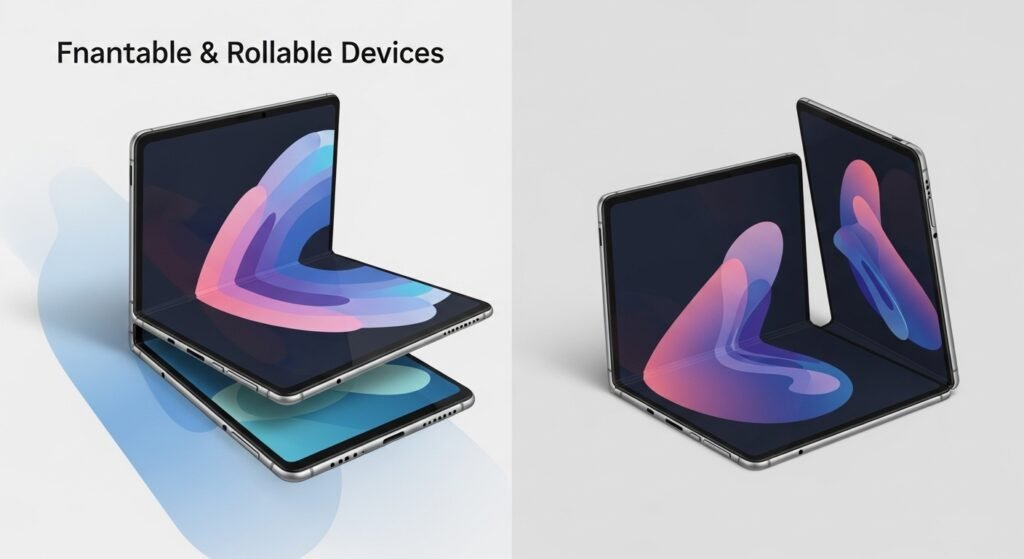
The foldable smartphone market is experiencing explosive growth that will fundamentally transform the mobile device landscape. Industry analysts project the foldable phone market will expand from $13.5 billion in 2025 to an astronomical $112.4 billion by 2035, representing a compound annual growth rate of 26.2 percent. This remarkable growth trajectory reflects technological maturation, addressing early durability concerns, expanding manufacturer competition, driving prices downward, and increasing consumer acceptance of foldables as legitimate alternatives to traditional smartphones.
Global foldable shipments reached 6.6 million units in the first half of 2025, with China growing 32.8 percent year-over-year, predominantly through Huawei’s Mate and Pura X models. While overall 2025 shipments remain relatively flat at 17.2 million units, 2026 represents the critical inflection point where analyst forecasts predict staggering 50 percent year-over-year growth as flip-style devices become increasingly affordable and competition intensifies across manufacturers. By 2028, foldables are projected to capture ten percent of the premium smartphone segment in markets including the UK and Germany.
Samsung maintains market leadership with the Galaxy Z Fold 7 and expanded Z Flip lineup, though its dominance is eroding as competition intensifies. Samsung’s global market share dropped from 45.2 percent in 2024 to a projected 35.4 percent in 2025. Huawei secures second position at 34.3 percent market share through strong Chinese market performance. Honor and Lenovo (Motorola) represent fast-growing challengers, with market shares climbing from 6 percent and 5.5 percent in 2024 to projected 9.1 percent and 7.6 percent in 2025, demonstrating aggressive expansion into mid-to-high-end foldable segments.
Technological Advances Driving Adoption
Early foldable phones suffered legitimate durability concerns—fragile flexible displays prone to scratches, hinges susceptible to failure after thousands of folds, and visible creases diminishing display quality. Manufacturers have systematically addressed these limitations through revolutionary engineering advances. Ultra-thin glass (UTG) displays provide superior scratch resistance compared to earlier plastic implementations. Reinforced hinge mechanisms now withstand hundreds of thousands of fold cycles without degradation. Advanced display technologies minimize crease visibility, with some manufacturers achieving nearly imperceptible creases through innovative hinge designs and flexible panel optimization.
Battery technology represents another critical advance. Dual battery configurations optimize power distribution across foldable form factors, while improved battery chemistry delivers all-day endurance despite larger, power-hungry displays. Fast charging and wireless charging compatibility have become standard, eliminating the inconvenience of extended charging times. Software optimization specifically designed for foldable displays ensures seamless transitions between folded and unfolded states, with applications automatically adapting layouts to available screen dimensions.
Android 16: Desktop-Class Productivity on Mobile Devices
Android 16 represents the most ambitious Android release ever, introducing desktop-quality multitasking capabilities that fundamentally transform how users interact with tablets, foldables, and phones connected to external displays. The cornerstone feature enables sophisticated window management where users can open multiple applications simultaneously in resizable windows, drag content between applications through intuitive gestures, and maintain productive workflows previously confined to desktop operating systems.
Adaptive apps become mandatory on Android 16 for any device with displays larger than 600dp in both dimensions—encompassing foldable inner screens, tablets, and Chromebooks. This requirement eliminates the fragmented experience where some applications refused to scale appropriately, instead stretching UI elements awkwardly or displaying phone layouts on tablet-sized screens. Developers must now ensure applications gracefully adapt to various screen dimensions, orientations, and multitasking scenarios, creating consistent experiences across Android’s diverse hardware ecosystem.
External monitor support transforms Android devices into genuine desktop replacements. When connecting an Android phone or tablet to an external monitor, the system activates desktop mode, providing taskbar navigation, window management, keyboard shortcuts, and mouse/trackpad support, rt mirroring traditional desktop operating systems. Applications can launch in floating windows, resize dynamically, and display across multiple monitors simultaneously. This capability enables professionals to use their Android device as their primary computing device, docking at workstations for desktop productivity, then undocking for mobile flexibility.
Live Updates: Revolutionary Notification System
Android 16 introduces Live Updates—a revolutionary notification paradigm enabling applications to display real-time progress information directly in notifications. Imagine ordering food delivery and watching a notification that dynamically updates, showing your order’s current status: order received, preparation started, out for delivery, arriving in two minutes. The notification visually represents progress through points and segments, creating informative experiences that eliminate the need to repeatedly open the application to check the status manually.
This foundation will expand to include Rich Ongoing Notifications displaying complex information like sports scores updating in real-time, stock prices fluctuating throughout the day, or package tracking showing precise delivery vehicle location. The notification system transforms from passive alert mechanisms into active information displays, keeping users informed without requiring constant app switching.
Cross-Platform Development: Efficiency Through Unified Codebases
Cross-platform development frameworks have matured dramatically, enabling developers to maintain single codebases that compile to both Android and iOS applications. Jetpack Compose Multiplatform and Flutter represent the leading frameworks driving this transformation, each offering distinct advantages. Jetpack Compose Multiplatform leverages Kotlin—Android’s official programming language—enabling developers to share business logic, data models, and increasingly UI code across Android, iOS, web, and desktop platforms while maintaining native performance characteristics.
Flutter continues dominating the cross-platform market share through its comprehensive widget system, excellent documentation, and vibrant community support. The framework’s hot reload functionality enables developers to see code changes reflected instantly without recompiling entire applications, dramatically accelerating development iteration speed. Flutter’s rendering engine draws UI elements directly rather than relying on platform widgets, ensuring pixel-perfect consistency across all platforms while maintaining 60fps performance targets.
The business advantages prove compelling. Development teams maintain a single codebase rather than separate Android and iOS implementations, reducing engineering costs by 30-50 percent compared to native development approaches. Feature parity between platforms occurs naturally since both platforms share the same codebase, eliminating the frustrating scenario where features appear on one platform months before the other. Bug fixes propagate across all platforms simultaneously, reducing quality assurance overhead and improving user experience consistency.
5G and Advanced Connectivity: Enabling New Application Categories
5G network deployment has reached critical mass in 2025, with coverage expanding beyond major metropolitan areas into suburban and rural regions globally. The transformative capabilities of 5G—ultra-low latency under 10 milliseconds, multi-gigabit download speeds, and massive device connectivity—enable entirely new application categories previously impractical on 4G infrastructure. Cloud gaming services deliver console-quality experiences with imperceptible input lag, enabling users to play demanding titles on modest hardware through remote rendering. Augmented reality applications overlay persistent digital information on physical environments, with multiple users experiencing synchronized AR content in real-time.
Remote healthcare consultation achieves new sophistication through high-definition video, real-time vital sign monitoring, and even remote surgical procedures where surgeons control robotic systems thousands of miles distant. Industrial applications leverage 5G for autonomous vehicle fleets, smart factory automation, and IoT sensor networks monitoring infrastructure across cities. These use cases demonstrate 5G’s transformation from incremental upgrade to fundamental infrastructure enabling previously impossible applications.
Sustainability and Eco-Conscious Design: Green Android
Environmental sustainability has transitioned from marketing differentiation to operational necessity across Android device manufacturers. Companies face increasing regulatory pressure for transparency around material sourcing, energy efficiency, and end-of-life device recycling. Fairphone exemplifies this trend through modular smartphone design, enabling users to replace individual components—batteries, cameras, displays—extending device lifespan from typical two-year replacement cycles to five years or longer. This approach reduces electronic waste while lowering the total cost of ownership for consumers.
Major manufacturers have committed to carbon-neutral manufacturing processes, renewable energy powering production facilities, and recycled materials comprising increasing percentages of device components. Samsung pledges that all mobile devices will incorporate recycled materials by 2025, while Google has committed to carbon-neutral Pixel production. Packaging has transformed from plastic-heavy containers to minimalist cardboard designs using recycled paper and biodegradable materials. These sustainability initiatives respond to consumer demand—surveys consistently show users prefer eco-conscious brands when price and features remain comparable.
Advanced Camera Capabilities: Computational Photography Dominance
Camera hardware specifications have plateaued as manufacturers recognize that computational photography—software processing applied to captured images—delivers more meaningful improvements than additional megapixels or larger sensors. Google’s Pixel devices exemplify this philosophy, consistently producing exceptional photographs from relatively modest camera hardware through sophisticated machine learning algorithms. Features like Magic Eraser remove unwanted elements from photographs, Photo Unblur rescues motion-blurred images, and Night Sight captures stunning low-light imagery rivaling dedicated cameras.
AI-powered camera coaching represents the latest evolution. Samsung and Google devices now analyze scenes in real-time, offering composition suggestions, lighting recommendations, and framing guidance overlaid directly in the camera viewfinder. Novice photographers receive expert-level guidance, producing dramatically improved results without requiring technical photography knowledge. Portrait mode has evolved beyond simple background blur—AI now understands three-dimensional scene geometry, preserves fine details like individual hair strands, and applies professional-quality lighting adjustments mimicking studio portrait setups.
Enhanced Security: Protecting Users in Evolving Threat Landscape
Android security continues advancing through comprehensive threat detection, automatic security patching, and hardware-level protections. Android 16 introduces Advanced Protection Mode—previously reserved for high-risk individuals like journalists and politicians—as an option available to all users prioritizing maximum security. This mode enforces verified boot, operating system integrity, runtime integrity monitoring, detecting malicious code execution, and automatic device reboots after extended inactivity, cutting off persistent malware sessions.
Developer verification requirements launching in 2026 mandate that all applications installed on certified Android devices be registered by verified developers. This accountability measure eliminates anonymous malware distribution, as developers must provide verifiable identity information, preventing bad actors from repeatedly publishing harmful applications under different pseudonyms. Google Play Protect scans over 200 billion applications daily through a machine learning system, identifying malicious behavior patterns, with malware prevalence in Play Store apps remaining over fifty times lower than sideloaded applications from untrusted sources.
Wearables and Connected Ecosystems: Seamless Device Integration
Android wearables have matured into essential components of comprehensive digital ecosystems rather than standalone gadgets. The Galaxy Watch 8 and Pixel Watch 4 demonstrate this evolution through deep integration with smartphones, smart home devices, and cloud services. Health monitoring capabilities have expanded dramatically—continuous heart rate monitoring, blood oxygen tracking, sleep analysis, stress detection, and even electrocardiograms generate comprehensive wellness insights. The data synchronizes automatically across devices, enabling users to review detailed health analytics on smartphones or tablets while wearing compact wearables.
Smart home integration transforms wearables into universal remote controls. Voice commands through watch microphones control lights, thermostats, security systems, and entertainment devices without requiring smartphone access. Notification mirroring ensures users stay informed about important alerts without constantly checking phones, while smart reply features enable quick message responses directly from wrist displays. The cumulative effect creates seamless ecosystems where information and control flow effortlessly across devices based on context and user preference.
The Developer Experience: Tools and Platforms Evolution
Android Studio has incorporated revolutionary AI-powered development assistance through Gemini integration. Developers describe complex functionality in natural language, and the AI generates corresponding code, suggests optimizations, identifies potential bugs, and even writes unit tests automatically. GitHub Copilot integration provides inline code suggestions as developers type, dramatically accelerating implementation speed. These AI coding assistants don’t replace developers—they amplify productivity by handling boilerplate code generation, documentation writing, and routine implementation tasks, freeing developers to focus on architecture design and complex problem-solving.
Firebase continues evolving as the comprehensive backend platform supporting modern Android applications. Cloud Firestore provides scalable NoSQL database storage with offline synchronization, Authentication handles user management across multiple identity providers, Cloud Functions enables serverless backend logic, and Analytics provides detailed user behavior insights. The integrated platform eliminates the complexity of assembling disparate backend services, enabling small teams to build sophisticated applications previously requiring substantial infrastructure expertise.
Looking Forward: Android’s 2026 Trajectory
The trends dominating 2025 will accelerate and converge throughout 2026. Foldable devices will capture increasing market share as prices decline and durability confidence strengthens. On-device AI capabilities will expand through more powerful neural processing units and increasingly sophisticated language models. Android 17 will build upon Android 16’s desktop productivity foundation, further blurring lines between mobile and traditional computing. Cross-platform development will become standard practice as frameworks mature and development teams recognize efficiency advantages.
Emerging technologies, including augmented reality glasses, neural interfaces, and ambient computing, will begin transitioning from experimental prototypes to consumer products. Android’s flexible architecture and Google’s AI leadership position the platform ideally for this next computing paradigm, where devices disappear into the environment, always available but never intrusive. The smartphone as we know it may represent merely a transitional form factor between past and future computing experiences.
Conclusion: Embrace the Android Revolution Today
The explosive Android trends dominating 2025 represent fundamental transformations reshaping mobile technology’s future trajectory. On-device AI integration preserves privacy while delivering instantaneous intelligence. Foldable phones evolve from exotic novelties into mainstream alternatives offering unprecedented screen real estate in pocketable form factors. Android 16 delivers desktop-qualityproductivityy transforming tablets and phones into legitimate laptop replacements. Cross-platform development maximizes efficiency through unified codebases. Enhanced security protections defend against evolving threats. Sustainability initiatives reduce environmental impact while maintaining performance excellence.
Understanding these trends empowers informed decisions about device purchases, application development strategies, and technology adoption timelines. Whether you’re a consumer seeking your next smartphone upgrade, a developer building tomorrow’s applications, or a business professional leveraging mobile technology for competitive advantage, these trends directly impact your Android experience. Stay informed, embrace innovation, and unlock the ultimate mobile revolution that Android’s explosive 2025 trends deliver. Your future mobile experience has arrived—it’s time to dominate it.