
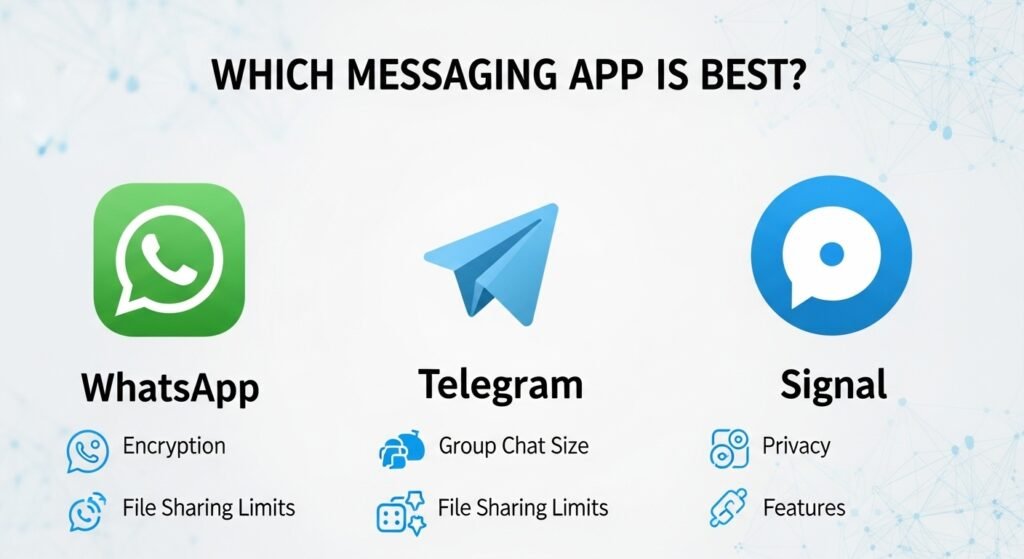
Choosing a messaging app might seem simple—just pick what your friends use, right? But beneath the surface of WhatsApp, Telegram, and Signal lie fundamentally different philosophies about privacy, security, and how user data should be handled. In 2025, as digital surveillance concerns grow and data breaches make headlines regularly, understanding these differences has never been more important. This article breaks down the technical differences, user experiences, and real-world implications of each app so you can make an informed choice based on what actually matters to you.
The Encryption Question: Understanding What’s Actually Protected
One of the most confusing aspects of messaging app comparison is understanding what encryption actually protects. All three apps claim to offer security, but they approach it differently.
Signal’s approach is comprehensive encryption by default. Every message you send, every call you make, and every file you share is protected end-to-end. This means even Signal’s own servers cannot access your communications. Signal uses the Signal protocol, an open-source encryption standard that’s considered the gold standard in the industry. Beyond message content, Signal uses a “Sealed Sender” feature that protects your metadata—information about who is communicating with whom and when.
WhatsApp’s encryption covers message content but not metadata. WhatsApp uses the same Signal protocol under the hood, meaning your actual messages are protected the same way as Signal. However, WhatsApp collects and shares extensive metadata, including your phone number, IP address, device information, account registration details, and usage patterns, with Meta, its parent company. Your message content stays private, but Meta knows who you’re talking to, when you’re active, and your device details.
Telegram’s encryption is selective and optional. By default, regular chats are not encrypted at all—Telegram stores them on cloud servers in plaintext, though they claim this makes the service more convenient and faster. Secret chats offer optional end-to-end encryption using Telegram’s proprietary MTProto protocol, but users must manually enable this feature for one-on-one conversations. Group chats on Telegram are never end-to-end encrypted, meaning Telegram can theoretically access group conversations.
The bottom line: Signal encrypts everything by default, WhatsApp encrypts content but not metadata, and Telegram leaves most conversations unencrypted by default.
Data Collection: What Information Each App Gathers
Privacy isn’t just about encryption—it’s also about what data companies collect about you in the first place.
Signal’s philosophy is data minimalism. The app requires only a phone number for registration and collects essentially nothing beyond that. Signal doesn’t store your contacts, doesn’t track your online status, doesn’t monitor which chats you access, and doesn’t collect device information. If someone requests your data from Signal, there’s very little data available to hand over. This minimalist approach is intentional—Signal is operated by the Signal Technology Foundation, a nonprofit organization with no commercial incentive to monetize your data.
WhatsApp’s data collection is extensive. Beyond the message content itself, WhatsApp gathers your phone number, contact lists, IP addresses, device information, operating system details, battery usage, app crash logs, and usage patterns. This data is shared across Meta’s ecosystem and potentially used for advertising and other commercial purposes. While WhatsApp claims not to store your message history, call history, or location data on its servers, the metadata collection remains substantial.
Telegram’s data collection falls between the two extremes. Telegram requires a phone number and collects your username, user ID, and contact information. The company collects less invasive data than WhatsApp but more than Signal. Notably, Telegram collects IP addresses and profile data, and doesn’t hide your phone number from message contacts by default. Telegram is owned by Pavel Durov and operates as a for-profit company, though it’s not owned by a larger tech conglomerate like Meta.
Metadata Protection: The Hidden Layer of Privacy
Metadata is information about your communications rather than the content itself. It includes who you’re talking to, when you’re talking to them, how long conversations last, and how often you communicate with specific people.
Signal protects metadata using its Sealed Sender feature, which hides sender information from Signal’s servers. This means even Signal cannot see who is sending messages to whom on their platform, only that communication is occurring.
WhatsApp exposes metadata to Meta. The company can see contact patterns, communication frequency, when you’re active, and device details. For users in sensitive situations—journalists, activists, or people in oppressive regimes—metadata exposure represents a real security risk.
Telegram’s metadata handling varies. Regular chats expose metadata, but Secret Chats with metadata protection are available in one-on-one conversations. Group chats, channels, and public conversations on Telegram expose full metadata.
Practical Features: Ease of Use and Functionality
While security matters, so does usability. Apps that are too difficult to use get abandoned.
Signal offers a clean, minimalist interface focused on core messaging features. You can send messages, make voice and video calls, share media, set disappearing messages, and enable screen locks. Signal now supports group chats up to 1,000 members with full encryption. The app works smoothly across iOS, Android, Windows, macOS, and Linux. One limitation: Signal has fewer than 50 million active users globally, so not everyone you know may be on the platform.
WhatsApp has the widest user base with over 1.5 billion users worldwide. The app supports group chats up to 256 members, video and voice calls, media sharing, and business features. WhatsApp is intuitive for most users and likely already installed by most of your contacts. Multi-device support exists but remains somewhat limited compared to Signal.
Telegram is the feature-rich option. Supports group chats with up to 200,000 members and unlimited-size public channels. Telegram excels at file sharing (up to 2GB per file), bot support, channel management, and customization. The cloud-based approach means your messages are accessible across devices seamlessly. With approximately 800 million users expected to grow to 1.5 billion, Telegram has become especially popular in communities around shared interests and for business automation.
Rebuilding Trust: Security Track Records
Security isn’t just about current features—it’s about track record and commitment to users.
Signal has no known major security breaches and operates with complete transparency. The codebase is open-source, meaning security researchers worldwide can audit the code and verify claims. Signal regularly publishes transparency reports and responds to security research quickly.
WhatsApp experienced a notable vulnerability in 2019 where attackers could install spyware through a malicious video call. While WhatsApp fixed the issue quickly and no evidence suggested widespread exploitation, the incident raised questions about security practices. As a proprietary app owned by Meta (a company known for privacy controversies), user trust remains a challenge for some.
Telegram is partially open-source but not fully transparent like Signal. The company has faced criticism for not being fully transparent about data handling and encryption security.
Real-World Usage Scenarios
Different people need different things:
If you’re communicating with family and friends locally and everyone uses WhatsApp, it offers solid message encryption even if metadata exposure bothers you less than others. WhatsApp remains the practical choice for mainstream communication.
If you participate in large communities, follow public figures, or want advanced bot-driven workflows, Telegram’s massive group support and feature richness cannot be matched by Signal or WhatsApp. Telegram is the tool of choice for community leaders, channels, and anyone needing a sophisticated messaging infrastructure.
If privacy is your paramount concern—whether you’re a journalist, activist, or simply value digital privacy—Signal is the only choice that protects both your message content and metadata comprehensively. Signal’s nonprofit status and transparency model make it the gold standard for privacy-conscious users.
Comparison Table: Security, Privacy, and Features
| Aspect | Signal | Telegram | |
|---|---|---|---|
| Default E2E Encryption | All chats | All chats | Regular chats, no |
| Metadata Protection | Yes – Sealed Sender | No | No |
| Data Collection | Phone only | Extensive | Moderate |
| Max Group Size | 1,000 | 256 | 200,000 |
| Active Users | ~40 million | 1.5+ billion | ~800 million |
| Open Source | Yes | No | Partial |
| Cloud Backups | Optional, encrypted | Optional, not encrypted | Automatic, encrypted |
| Self-Destructing Messages | Yes | Yes | Yes |
| File Share Limit | 100 MB | 100 MB | 2 GB |
| Best For | Privacy advocates | General users | Communities, channels |
The Honest Conclusion
There’s no single “best” messaging app—the choice depends on your priorities. WhatsApp wins on adoption and ease of use for everyday communication. Telegram wins on features and community-building potential. Signal wins on privacy and security. Most security-conscious users maintain accounts on multiple platforms, using Signal for sensitive conversations, WhatsApp for compatibility with most contacts, and Telegram for interest-based communities.
Your best messaging app is the one that balances your actual needs with realistic security expectations. If you communicate with average people about normal topics, WhatsApp’s message encryption is sufficient. If privacy feels existential to your safety or livelihood, Signal is non-negotiable. If community and features matter most, Telegram offers unmatched capabilities.
The important thing is making a conscious choice rather than defaulting to convenience—understanding what each app does with your data and communications helps you make decisions aligned with your values.